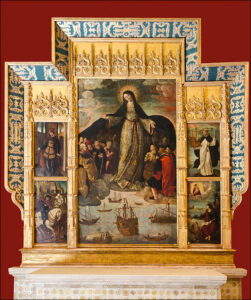
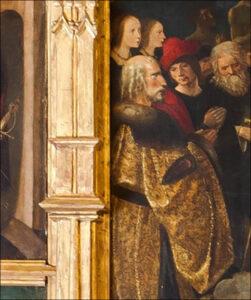
Columbus died in Valladolid, Spain, on May 20, 1506, five hundred twenty years ago today. During his lifetime, Queen Isabel’s court chroniclers and others who knew and wrote of him said that he was Genoese, from Genoa or its environs, and when they discussed his faith, that he was a devout Catholic. The first two photos show the portrait of him set within The Our Lady of Navigators altar mural contained in the Audience Room of Seville’s Royal Alcazar (drawn in the 1530s to depict Spain’s conquest of the “New World”).
In the centuries since Columbus’s death, many have challenged his Genoese origin and, to a lesser extent, his Catholic faith. According to a recent program on Spanish TV, a new genetic study of Columbus’s and his relatives’ remains concludes that Columbus was born in Western Europe, likely in Spain, and that he had Jewish ancestry and may have been Jewish. When I last traveled in Spain and the Dominican Republic, I was often asked about the program and my belief as to Columbus’s origin, ancestry, and faith. In short, I believe his contemporaries who knew him—perhaps unsurprisingly—were correct.
In my view, and that of most historians, overwhelming documentary evidence unambiguously establishes that Columbus was born in Genoa or its environs in 1451, as I’ve portrayed in all my books (which include citations to the evidence in the Sources sections). Ligurian notarial documents record various activities and real estate ownership of Columbus’s ancestors in Genoa commencing in the 1430s. Columbus’s own statements express his Genoese origin or pride therein (including testimony in a lawsuit in 1479; his testament in 1498; his letter to Genoa’s Bank of St. George in 1502). Writings of his friends (such as Michele de Cuneo) and critics so indicate. After the first voyage, he placed relatives and acquaintances who came from Genoa or its environs on his fleets, and he often relied on financing from Genoese or other Italian sources.
As for ancestry, I believe it’s plausible that Columbus had Jewish ancestors, and some historians, including the Italian Paolo Emilio Taviani, confirm this possibility. As discussed in Encounters Unforeseen’s Sources section, the Spanish historian Salvador de Madariaga argued, inter alia, that Columbus was born in Genoa into a Spanish–Jewish family that had emigrated from Catalonia to Genoa during the repressions of the 1390s, and while a sincere and devout Catholic, he was influenced by Jewish faith and loyal to that heritage as a descendant of conversos. The argument is compatible with both the Ligurian notarial records and the genetic study. An emigration of Jewish ancestors to Genoa, whether in the 1390s, before then, or up to forty years later to the 1430s, leaves at least two decades, if not six or more, for the lineage’s conversion to Catholicism before Columbus’s birth. Madariaga suggests that conversion most likely occurred at the time of emigration.
In my view, consistent with Jewish ancestry, Columbus’s writings reveal familiarity with the Old Testament (as well as the New Testament) and do not evidence the cultural anti-Jewishness prevalent in many of the era’s primary sources. As discussed in Encounters Unforeseen’s Sources section, he was comfortable in relationships with conversos (for example, Luis de Santángel) and accepted that a converso could become a true Christian, although he wasn’t above criticizing his enemies as conversos as depicted Isabel, Anacaona & Columbus’s Demise.
As for Columbus’s faith, all three of my books relate (and cite) some of his numerous writings over the decade commencing in 1492 that ceaselessly indicate a devout Catholicism. While it can be argued that a portion of these writings were calculated and dissembling, some were heartfelt and urgent, expressed alone at the precipice of death at sea or at the hands of enemies. When threatened or desperate, or simply when circumstances didn’t involve seeking favor or creating an impression, Columbus prayed to Christ the Lord, the Holy Trinity, or the Virgin Mary—often multiple times a day. Assuming that his ancestors were Jewish, I believe the lineage’s conversion would have occurred well before his birth and that he never perceived himself as Jewish.
You can find citations to other works debating Columbus’s origin, ancestry, and faith in the Isabel, Anacaona & Columbus’s Demise’s Sources section.
Whatever his religion, a darker (and non-Eurocentric) topic is whether Columbus ever prayed for the well-being of the Native peoples he conquered, exploited, and devastated. As depicted in Isabel, Anacaona & Columbus’s Demise, his enslavements of Taíno Indians while serving as “Española’s” governor from 1498 to 1500 fueled the contemporary observation that he cared more for enslavement than conversion. His writings reveal that he came to understand the horrific decline of Espanola’s Taíno population that followed his invasion; but Bartolomé de Las Casas characterized Columbus’s grief for that as directed to the loss of the gold that those who perished would have mined. While Columbus came to conceive of himself as Christ’s messenger to bring the Indians to the faith, his focus was shamelessly self-absorbed and not followed by consequential action.
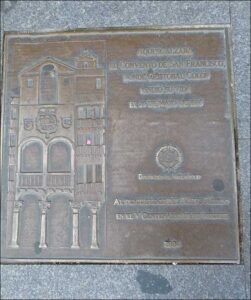
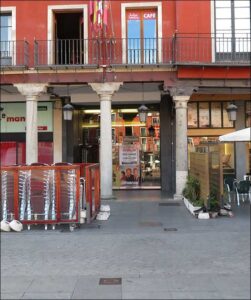
The building in Valladolid where Columbus died is largely gone, and when I visited some years ago, a coffee shop sat on the site. But there’s a plaque depicting the building (third photo) outside the coffee shop (fourth photo).