For Indigenous Peoples’ Day, I relate what is known about the Taíno Indians enslaved and sent to Spain by Columbus in 1498 and 1499 and then liberated by Queen Isabel’s decree of June 20, 1500 (summarized in my post of June 20) and returned home to “Española.” Only nineteen out of nearly one thousand slaves made it home.
In the spring of 1500, Isabel appointed a courtier, Pedro de Torres, to exhaustively search for and sequester the one thousand, but the overwhelming number had already died, and some surviving could never be found. Torres succeeded in locating twenty-six, thirteen men and boys and thirteen women and girls. Five of the women and girls died of disease while sequestered before the decree, including an Isabel, a Juana, a María, and a Catalina—names conferred by their slave masters, presumably honoring Isabel and her surviving three daughters.
After the decree, the twenty-one remaining were entrusted to friars sailing with Francisco de Bobadilla when he departed for Española at the end of June 1500 to replace Columbus as the island’s governor. These Taínos included a few Juanicos, two more Catalinas, and another María, with the rest bearing other common Spanish names conferred by their slave masters, including an Alfonso, Diego, Johan, and Matheo. Most had toiled in Andalusia. Some of the masters who relinquished them had returned from Española with them. Others were subsequent purchasers.
Purportedly, one of the Taínos, a twelve-year-old girl, indicated that she wished to remain in Seville as a free person, and she was released to a Sevillian for his care—or perhaps to serve him. One of the Juanicos succumbed prior to departure, leaving only nineteen.
When the ships arrived in Española on August 23, the Taínos were released ashore, and to my knowledge, nothing is known of their fate thereafter with one exception. One of the surviving Juanicos had been Bartolomé de Las Casas’s slave (given to Bartolomé by his father, who’d served in Española), and Las Casas does report meeting Juanico on Española when Las Casas lived there.
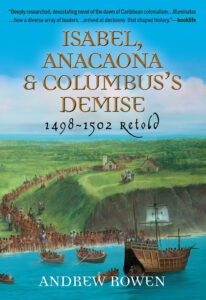
I haven’t found an historic image of the nineteen. I repost the cover page of Isabel, Anacaona & Columbus’s Demise; you might imagine some of the nineteen among the eight hundred being loaded on the ships in nascent Santo Domingo in 1498.