
On June 20, 1500, five hundred twenty-six years ago today, Queen Isabel and King Fernando issued their sparse royal decree freeing “Indian” slaves whom Columbus had shipped to Spain and directing that the Indians be returned to “Española.”
Previously, Isabel and Fernando had permitted Columbus to enslave Indians who warred against their conquest. But they had repeatedly demurred on Columbus’s enslavements of, and requests to enslave, other Indians, wishing peaceful Indians to be treated as their vassals yet cognizant that many of their kingdoms’ merchants and financiers—as well as their settlers on Española—wanted broad Indian servitude. As depicted in Columbus and Caonabó, in 1495 Isabel explained that learned men, theologians, and lawyers first needed to advise on permissibility, initially ducking responsibility for the decision.
As related in Isabel, Anacaona & Columbus’s Demise, Isabel grew enraged by Columbus’s subsequent shipment of non-resisting, enslaved Indians to Spain in 1498 and 1499 and repeatedly exclaimed “What power does my admiral have to give anyone my vassals?” Her conscience couldn’t tolerate further vacillation, and in my view, the 1500 decree spoke her conscience and will alone; it didn’t invoke a conclusion of theologians or lawyers, after years of purportedly waiting on such. Columbus’s successor governors on Española understood that enslavement of non-resisting Indians was thereafter prohibited. Yet Isabel’s conscience and will were bridled to placate mercantile, settler, and conquistador interests—the decree expressed no principle freeing other Indians already enslaved in Española or by persons beyond Columbus’s command.
The decree was hardly impetuous or quickly drawn. Isabel appointed a courtier to exhaustively search for and sequester the Indians months before issuing the order. Regardless, disease and servitude had taken its toll; out of some thousand Indian slaves sent to Spain, merely twenty-six were found prior to June 20, and nineteen survived to depart for Espanola with Columbus’s successor by the end of the month.
Enslavement of Indians “resisting conquest” remained permitted and, as Isabel, Anacaona & Columbus’s Demise dramatizes, Isabel’s explorers and territory governors in the Indies thereafter justified fresh Indian enslavements simply by asserting that those whose homeland they invaded had resisted. On Española (and later in the Americas), forced labor of non-resisting Indians would be justified and theoretically distinguished from slavery—the doctrines of repartimiento and encomienda.
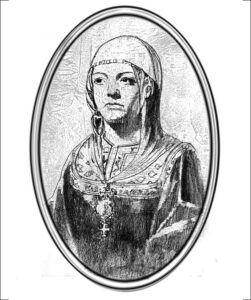
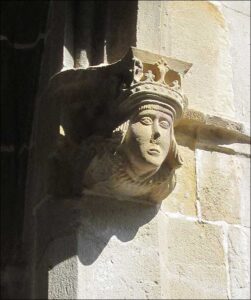
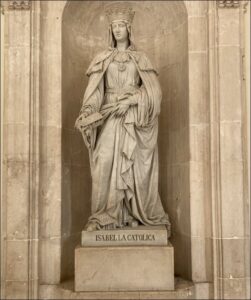
The photos show the premodern bust of Isabel found in the Monastery of Sant Jeroni de la Murtra in Badalona (north of Barcelona) and the modern statue of her in Madrid’s Royal Palace. The sketch is that newly drawn for the book’s title page.