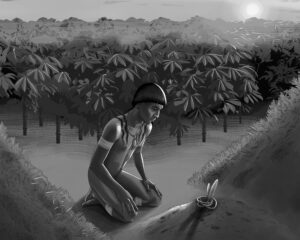
My first two books trace the life of the Taíno Indian Diego Colón, Columbus’s longest-serving enslaved interpreter, and Diego continues as a protagonist in Isabel, Anacaona & Columbus’s Demise.
As depicted in Encounters Unforeseen, Diego was a Lucayan Taíno born on Guanahaní (San Salvador) circa 1480, his birthname unknown (I fictionalize it to be Bakako). Columbus abducted him there (with six others) on October 14, 1492, whereupon he served as a guide and interpreter for Columbus’s first voyage as it sailed through the Caribbean. Columbus took him to Spain at the end of the voyage, and in June 1493, he was baptized Diego Colón in Barcelona before Queen Isabel.
As related in Columbus and Caonabó, Columbus used Diego as the principal interpreter on the second voyage and the exploration of Cuba, as well as in the conquest of “Española,” where he translated Columbus’s parleys with and orders to Española’s supreme chieftains (1493-1495). In early March 1495, Columbus and Chief Guarionex agreed a truce permitting Columbus to establish a trading fort near Guarionex’s village, and to cement the understanding, Diego and one of Guarionex’s sisters were married, whereupon Diego went to live near the fort and serve as Columbus’s emissary to Guarionex and spy. Before departing for Spain in 1496, Columbus awarded Diego a village and farmland near Guarionex’s village as Diego’s own chiefdom.
Columbus returned from Spain on his third voyage in 1498, and as narrated in Isabel, Anacaona & Columbus’s Demise, he occasionally resumed using Diego in parleys with chieftains until his removal as Española’s governor in 1500. Columbus’s immediate successor as governor, Francisco de Bobadilla, apparently had no use for Diego. In 1502, Bobadilla’s successor Nicolás de Ovando summoned Diego to serve, and Diego relocated with his family to Santo Domingo. After eight years of servitude to Columbus, Diego would then serve Ovando for several years.
The sketch of Diego shown below was drawn for Isabel, Anacaona & Columbus’s Demise, imagining him in 1498 when about eighteen.