
The historical record is largely silent as to what Queen Isabel and Chief Anacaona understood about each other. They were separated by an ocean and of different civilizations just met. For Women’s History Month, I deduce or speculate what each had come to know of the other through 1502, including as depicted in scenes of Isabel, Anacaona & Columbus’s Demise: 1498–1502 Retold.
Anacaona would have long understood that Isabel’s conquest was made in Isabel and King Fernando’s name and assumed that Isabel either directed or acquiesced in the conquest’s brutality and deceits. Anacaona also witnessed, and sought to exploit, multiple rebellions by Isabel’s men against Isabel’s leader Columbus, which indicated that Isabel lacked control of her subjects. During the period, Isabel learned of and unsuccessfully tried to address her conqueror’s abuses, particularly against Taíno women, but Anacaona wouldn’t have perceived those efforts.
Isabel would have understood that Anacaona had been Chief Caonabó’s wife and widowed following his war of resistance and imprisonment by Isabel’s men. Isabel also would have received reports that Anacaona had accepted coexistence with Isabel’s settlers rather than continuing her husband’s war. By 1502, Isabel learned that Anacaona had ascended to become Xaraguá’s ruler after Chief Behecchio’s death.
Each woman also likely learned some intimate details about the other’s life—Anacaona when hosting parleys with Francisco Roldán, Bartolomé Colón, Don Fernando de Guevarra, and Alonso de Hojeda, Isabel when granting audiences to three of these men and others. Scenes of Isabel, Anacaona & Columbus’s Demise dramatize Anacaona learning of Isabel’s resolve as a warrior queen and sadness over the loss children and Isabel learning of Anacaona’s stature as a poet and the adoration she commanded from her subjects.
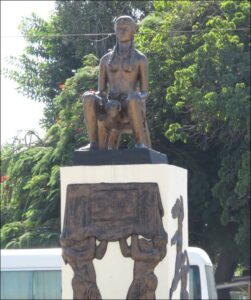
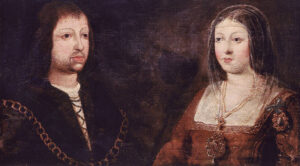
Prior posts have included some of the better-known portraits, statues, and sketches of the two rulers, as well as the sketches of them drawn for Isabel, Anacaona & Columbus’s Demise. Rather than depictions of their later-life eminence as rulers, I post two images showing them when younger. The statue of Anacaona sits in the Plaza Anacaona in San Juan de la Maguana, Dominican Republic, the site of Caonabó’s hometown, where she lived after marrying him when a teenager, ca. 1480. Isabel’s wedding portrait depicts her at eighteen in 1469, courtesy of the Convento Augustinas, Madrigal, Avila, Spain (15th century).